Minister of Communications: Egypt's digital exports reached $7.4 billion over seven years.
Outsourcing exports doubled in three years to reach $4.8 billion.
Dr. Amr Talaat, Minister of Communications and Information Technology, confirmed that the performance indicators of the communications and information technology sector have witnessed continuous development over the course of 7 years, as the sector maintained its position as the highest growing sector in the country, achieving growth rates ranging between 14 to 16%. Its contribution to the gross domestic product also increased from 3.2% to 6% during the current year. He pointed out that digital exports increased by 124% to reach $7.4 billion compared to $3.3 billion in 2018, and outsourcing exports increased from $2.4 billion in 2022 to $4.8 billion in 2025. The number of companies operating in this industry in Egypt also increased from 90 companies to 240 companies with more than 270 centers to provide outsourcing services.
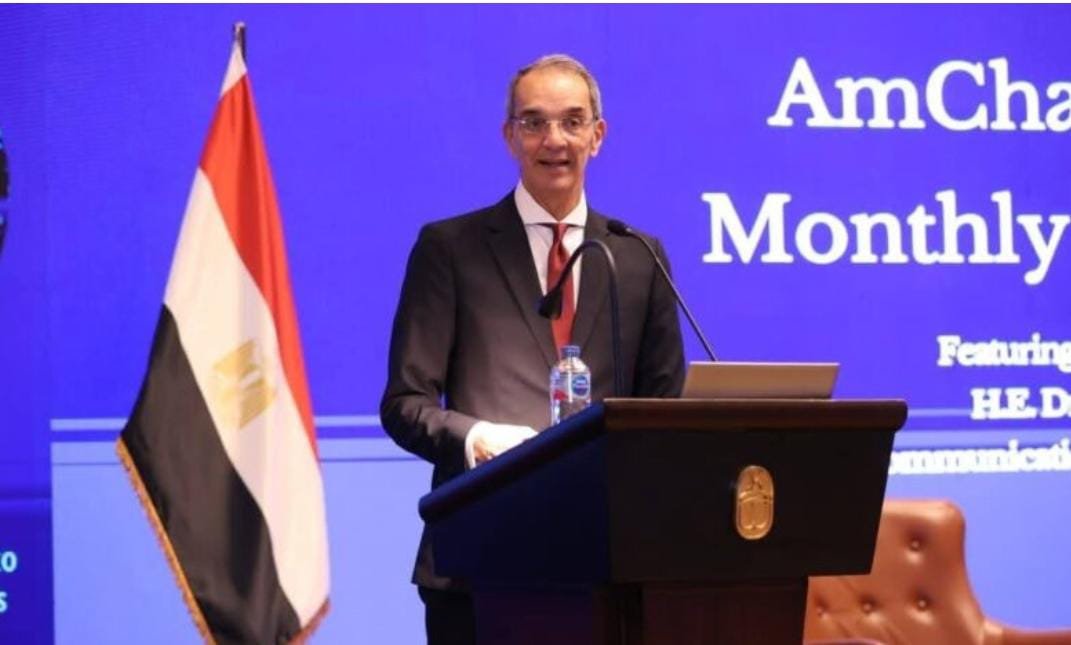
This came in a speech by the Minister of Communications during the monthly meeting of the American Chamber of Commerce in Egypt, during which he discussed the vision and work axes of Egypt’s digital strategy, and the developments witnessed by the communications and information technology sector over the past 7 years.
Talaat explained that Egypt’s digital strategy includes four main pillars: promoting digital innovation, developing digital services provided to citizens, driving GDP growth and exports, and creating job opportunities in the digital economy, based on two fundamental pillars: digital infrastructure and a supportive legislative environment.
The Ministry stressed its keenness to increase the number of qualified personnel in the fields of communications and information technology, to implement digital transformation projects, as well as being one of the main factors to attract global companies to establish centers for them in Egypt, noting that the number of trainees annually in technological specializations has increased 200 times over 7 years, rising from 4,000 trainees in the fiscal year 2018/2019 to 500,000 trainees during the last fiscal year, and a target of training 800,000 trainees in the current fiscal year.
Talaat explained that the digital capacity building strategy includes two main models: formal education and vocational training. It aims to align educational and training programs with the requirements of the labor market. He noted that the first batch of students from the Egypt University of Informatics, which was established in the New Capital, has graduated. This was done within the framework of the Ministry of Communications and Information Technology's vision to provide high-quality educational programs in an advanced educational environment to prepare and graduate distinguished talents in the fields of communications and information technology. He also pointed to the WE Applied Technology Schools, which started with one school in 2021 and have expanded to 27 schools spread across all governorates.
Talaat pointed to the diversity of mechanisms for delivering training programs, which include traditional direct training, training via digital platforms, in addition to expanding blended training models that combine study inside training halls and online learning; referring to the Mahara Tech platform, which provides specialized digital training content in many technological fields.
The ministry stressed its commitment to building an integrated skills matrix for trainees, including technical, linguistic and personal skills, in addition to freelance work and entrepreneurship skills, as well as focusing on programs to qualify young people to join the freelance labor market, in addition to providing training programs for non-specialists in the field of information technology to help them develop professionally using artificial intelligence, pointing to the Digitopia competition launched by the ministry with the aim of discovering talents in the fields of digital creativity.
He pointed out that the National Strategy for Artificial Intelligence was launched in 2019, and the implementation of its pillars contributed to Egypt's ranking advancing by 46 places in the Government AI Readiness Index. He added that the second version of the strategy was launched at the beginning of this year and includes 6 pillars: data, skills, ecosystem, infrastructure, applications, and governance. He emphasized that work is underway to build systems using artificial intelligence technologies to improve the efficiency of services, as a system for early detection of breast cancer and another for converting spoken text into written text in court sessions have been launched.
The Minister of Communications also reviewed the most prominent achievements in enhancing Egypt’s position on the global outsourcing industry map and attracting more investments to Egypt; noting the signing of agreements last November with 55 global and local companies to expand their investments in Egypt in the field of outsourcing, which will provide about 75,000 new job opportunities during the next three years.
He added that agreements had already been signed with 29 companies in 2022 to expand existing outsourcing centers or establish new centers in Egypt, with the aim of providing 34,000 job opportunities over 3 years, stressing that this number has risen to 60,000 new job opportunities that were implemented until the end of 2024.
Talaat explained that there are 15 brands currently manufacturing mobile phones in Egypt, with a local added value of about 40%, noting that production capacity will increase from 3.3 million units during 2024 to 10 million units during 2025.
He also reviewed the developments of the Egypt Digital Services platform, explaining that it currently offers 210 government services and that the number of users of the platform has reached more than 10 million users; noting that about 2 million transactions are carried out monthly.
Talaat pointed out that investments worth $6 billion have been injected since 2019 to improve the efficiency of the fixed and mobile internet network, including $2.7 billion to improve mobile services, in addition to $3.3 billion to improve the efficiency of the fixed internet, which contributed to increasing its average speed by about 16 times to reach 91.3 megabits/second, so that Egypt topped the ranking of average fixed internet speed compared to the fortieth place in 2018.
He explained that the second phase of the project includes expanding the deployment of the fiber optic network nationwide, and connecting the approximately 4,500 villages of the Decent Life initiative with fiber optic cables. He noted that 5G services, Wi-Fi Calling, and IoT (Internet of Things) services for cars have been launched, in addition to implementing a system for governing marketing calls via telephone. He pointed out that more than 901 TP3T of data traffic between Asia and Europe passes through Egypt, via 21 international cables, including 6 cables currently under construction.
He pointed out that, within the framework of the policies and legislation regulating the communications and information technology sector, the Information Technology Crimes Law, the Personal Data Protection Law, the Egyptian Charter for Responsible Artificial Intelligence, the Cloud First Computing Policy, and the Open Data Policy have been launched.